‘Axe The Tax’

If one was to pen a business plan for racing, it would have one action plan

  1. When things go wrong in racing’s ship – put the prices up on the bookmakers

Racing, and racetracks don’t seriously consider actually improving the product. They don’t look at days like Super Saturday and decide it needs trimming for effectiveness. They will schedule a race to go off ten minutes after the Grand National, and cut to it by contract stipulation. They put on extra days on racing festivals and fill them with handicaps. Or split championship events like the Cheltenham Gold Cup and the Champion Hurdle. The regulator is ruled by the will of the tracks for wall to wall racing, and cheap black type, and shows no appetite for real change

As a career bookmaker, I’ve always known, whilst not accepting, that racing as a product is disproportionately expensive. I require a much higher margin to absorb exorbitant streaming charges, levy, duty and marketing of the same. Racing does represent a far higher share of my customers interest. That won’t be true of the likes of 365 however, where racing might attract just ten percent of the giants product turnover.

Is it any wonder, therefore, when racetracks like Arena hike their streaming charges up by circa 20 percent, that the likes of Flutter simply say no. Arena was already expensive, for a product that several days a week might have little or no product to display. Bookmakers need content, and they need it to be compete favourably with Man Utd vs Man City. Arena, however, isn’t profitable. To that end I understand the money quest- but you can’t just put the prices up to make yourself look more attractive on the market.

In similar vein racing ‘expects’ a greater levy share. Levy is simply another ‘tax’ bookmakers pay. Racing wants more levy to fund its offerings at a time when the amount of betting on sports in 2024 declined by 9 billion pounds! Exacerbated by highly restrictive business practices such as ‘affordability checks’ which have seen many high end players simply depart the UK market

Let us be clear- affordability checks aren’t the fault of racing. It is policy which emanated from an over zealous gambling commission, embarked on a ‘public health’ mission, rather than acting as the gambling regulator. Racing and racetracks have fought these checks almost isolated. Few bookmakers have publicly said anything. Certainly not the major bookmakers, and their marketing arm, the ‘Betting And Gaming Council.’ Who have publicly supported affordability, rather than challenge deeply unpopular policy. To be fair the BGC has a outstanding record in fail.

Leading the fight, in a leadership vacuum only Racing can create (no CEO for 2 years?) has been Martin Crudace. A smart cookie who heads Arena Racetracks. He’s been an immovable object in the path of gambling reformers. His powerful, persuasive, argument is simple. Affordability checks haven’t reduced the (already world wide low) level of problem gambling by one person. They don’t work. A stance the gambling commission now accepts, but won’t admit (their involvement)

Opposing gambling in pretty much all of its forms is Derek Webb. Webb invented the casino game ‘3 card poker’ – a voracious product so profitable to casinos it often fronts the house. Gambling made him a very wealthy boy, and he sees no irony that he is now using all the money he earned from a highly lucrative casino game into anti activism. Chucking out millions to impose his new morals on the industry. For example funding the opposing candidate to Philip Davies at the last election. Paying for loaded ‘survation’ surveys and other research specifically designed to portray gambling as somehow dirty. He doesn’t accept people’s right to choose. To bet at whatever level they prefer, and under their own controls. Nor their right to the privacy of their data, with demands for affordability and ‘single customer view’ access to people’s finances.

Yet he now appears to have untangled racing from sports betting and by all accounts the SMF (which Webb funds) is working with racing

Also at the altar of sponsored opinions are activists against gambling- like James Noyes. He is a left wing academic, funded by Las Vegas philanthropist Derek Webb. In 2020 Noyes argued passionately, without a shred of evidence, that affordability should be implemented at levels as low as £23 of customer deposits a month. It was an absurd and irrational argument, especially given the clear opposition to such plans from punters. In the last year alone, sports betting has declined by some 9 billion pounds, and hasn’t saved a single individual from harm. Noyes now describes affordability as a ‘fiasco’ yet he drove the policy irresponsibly. He now wants Racing to commit to his new plan- to split horseracing out from all other betting products. Notably sports.
However, he has now managed the conjuring trick of convincing Crudace in the new ‘Axe The Tax’ campaign that racing should speak only for itself. It is a smart move, one would have thought noone would countenance. Noyes, and his benefactor Webb, appreciate that with Crudace and Racing out the way, they can advance their cause to establish gambling, and notably sports betting as a health emergency (The words of Noyes). The removal of horse racing objections representing a major step in SMF ambitions to raise gambling taxes to prohibitive levels, and the acceptance of sports betting as a harmful product. We have even hear Zarb-Cousin argue on the Luck show that horse racing represents less of a welfare issue than greyhounds. Who is he kidding?

The SMF appear to be running the show. They will both, of course, claim that they are not anti gambling, but when you advocate restrictions on gamblers and their activities, sponsorship of gambling, huge tax rises, advocation of affordability checks at absurdly low levels, and prohibitive practices which you absolutely know can only send consumers to the black market? You’re a prohibitionist, you just don’t like being called one.

What is the issue with ‘splitting out’ racing? Well it is exactly like advocating in a supermarket, that the milk, tea and eggs be treated as ‘favourable products.’ The argument is racing to be afforded a low duty rate, and the decrease in duty made up by a commensurate increase in levy! In exchange, racing will ‘stand aside’ from any involvement in the rest of the sports betting package bookmakers sell. This ‘splitting out’ of racing, notably excludes greyhound racing from any tax break. An astonishing position! Thrown to the dogs, as they say?

Aveek Bhattacharya, the Social Market Foundation man at the treasury, was formerly funded by Webb at the SMF, has somehow managed to have himself installed as the head of excise at the treasury. A policy position of incredible influence. The fact that Webb funds the Labour party of late to the tune of 1.5 million raises the more than reasonable speculation of cash for favours. You’re allowed to donate to political parties, but you’re not supposed to expect ‘treats.’ We all accept that to be nonsense. But the relationship with Bhattacharya, the SMF and Webb is undisputed. Webb is playing his orchestra with far more skill than those representing racing and betting, and Noyes believes he can smooch everyone onside, with a campaign of reasonable appeasement.

Bhattacharya, advocates that betting duties be ‘harmonised.’ In said regard his views are aligned with several student politic standard position papers opposing anything humans like to enjoy he has penned in the past. Like smoking, drinking, and of course gambling. He is no friend of anything humans consider enjoyable pastime. The suggestion is sports betting be raised to 21% – the current rate of remote gaming. Racing wants its own level set at 10%. And the difference made up by an appropriate increase in levy. I hope you’re following this?

Well, if this treasury official gets his way, sports betting will be hiked by 40%. Racing thinks it will be exempt, and there’s a more than fair chance that’s precisely what will happen. Since it is a heritage sport all would want to survive. The callous advocation by racing, and the tracks, a form of cognative dissonance, that it should all be about them, leaves bookmakers shouldering a huge duty increase. And potentially levy too.

The trouble with this is how bookmakers operate. A shop, or online firm, that offers racing, offers that product as an element of various sports. Without football for example, no betting shop would be viable. Nor any online business for that matter!

So why such a naïve stance?

Well it is difficult to understand such folly. Racing must believe the unsupportable tax hike in sports betting will simply be absorbed by the 4 largest companies. They calculate the loss of the independent market as a ‘price worth paying.’ No independent can withstand such a rise in tax. And to pass the duty cost on by delivering higher margin, or by removal of offers, like best odds guarantees, robs bookmakers of any competitive advantage against the black market- who pay a zero rate of tax and levy!

It follows the racing alliance believes big corporations, like the 35 billion pound Flutter should ‘just pay.’ Because it can afford to. Racing has deep history with such views. Even if racing is a loss leader to the gaming companies.

It is a bold plan. One born of the beer mat and the incredibly smart Derek Webb, who has managed to split the immovable racing out. Flutter, for example are already saying no to hikes in streaming and levy. Quite why racing thinks it can ‘bully’ such companies into ‘just paying?’ Well that goes back to rule number 1. Which I repeat

  1. Bookmakers should just pay.

The future

If racing gets its way, it must believe the ‘split out’ can last ad infinitum. In reality those who oppose gambling on moral grounds, and horse racing on welfare, will be unrelenting in their opposition to racing being treated as a special case- when it causes so much (imagined) harm. Racing will end up ‘harmonised.’ The independent bookmaker market (that’s companies like Geoff Banks Online, Star Sports, Fitzdares etc) will disappear offshore. Acceptable collateral I believe that’s called. Finally racing thinks government will be able to bully Flutter, Entain, Evoke and 365 into a new world of 40 percent uplifts in tax and levy. Play stupid games- win stupid prizes

If I was the CEO of Flutter, or Entain, and racing wins the round in securing for itself more levy, whilst turning its back on its association with sports? Well I would find I have two products ‘harmonised’ for tax at the same high rate. There’s no tax advantage now to offer racing. One is my gaming with minimal cost attaching – the other is the racing, which is enormously expensive in charges to offer. Which part of my business would I be shoving down my customer’s throat? Inevitably it would be Racing that would suffer. And I wouldn’t lose a moments sleep about a sport that abandoned its defence of the other products which effectively offer punters a ‘one stop’ solution for their betting. Racing, having given the treasury the nod for huge tax increases in sport, has committed the biggest single act of immolation in its history.

Good luck to all those of you who think you can manage such a trick on companies domiciled in Gibraltar and Malta, I have said it before, but I will repeat. Racing has to look to itself and modernise. Punters? Well your future lies offshore. And as offshore entities like Stake prove they can pay winners – they will dominate the market. That’s if Flutter, 365, Evoke and Entain don’t set their shop up in Malta for good, and put two fingers up to racing, and this government.

Who could blame them?

Luqa, Malta – June 23, 2016: Air Malta Airbus A320

UK actions inspire hope and despair

the Player Protection Hub newsletter, your biweekly roundup of news, features, interviews, conversation, and new research; plus a guide to upcoming digital and real life events related to player protection and ESG in the gambling industry

UK actions inspire hope and despair
While the Gambling Commission’s action that has resulted in Stake leaving the UK market will delight regulated operators concerned about crypto competition, the UK government’s appointment of the Office for Health Improvement & Disparities (OHID) to administer £30m of public funds will please almost nobody.


Stake announced its withdrawal from operating white-label websites after the Gambling Commission investigated claims that Stake’s branding was found on a social video from porn star Bonnie Blue imploring “barely legal” Nottingham Trent University to have sex with her.The Commission will be congratulated for coming down hard on such irresponsible advertising and also finally tackling a crypto-first operator using a UK white-label site for the purpose of gaining a sponsorship deal with a Premier League football club (in Stake’s case, Everton).
After its action on Evolution Gaming’s presence on unlicensed operators, it will be seen as another sign of the Commission getting serious about the black market.
The Commission says it will write to Everton as well as two other clubs with unlicensed sponsors warning of their dangers.


Swings and Roundabouts:
However, the industry will be horrified by the appointment of OHID as prevention commission for £30m of RET funds, which, according to the government, could include measures such as national public health campaigns.
“They will see harm prevention and gambling prevention as the same thing,” Regulus Partners’ Dan Waugh told us today. OHID has a strong relationship with anti-gambling campaigners Gambling With Lives going back several years, which has resulted in people being deterred from using GambleAware’s National Gambling Helpline, among other things.OHID has also released research advocating for:
– Annual tax increases on the industry above the rate of inflation
– A universal advertising ban
– A ban on the sale of beer and wine in casinos, and possibly on racecourses
– Plain packaging for gambling products with no colours or logos or images.Lived experience concerns: Charity organisations such as Deal Me Out have expressed their concerns about OHID discriminating against organisations due to their funding models. This is an appointment that will please nobody except the prohibitionists at Gambling With Lives.

Court case threatens UK research, education and treatment agenda

The UK government’s decision to appoint the Office for Health Improvement & Disparities (OHID) as the Commissioner of a £30m industry levy to prevent gambling harms is coming under increasing scrutiny with the possibility the government ends up in court.

Concern has grown among Research, Education and Treatment (RET) providers that discriminatory practices at OHID have stopped them from providing their services under the current model and there is concern that it will just get worse when OHID becomes the sole commissioner.

Player Protection Hub has learned that lawyers are advising on the possibility of a judicial review to halt the appointment.

A public health approach:

The Prevention Commissioner’s role is to develop a “comprehensive strategy” to reduce gambling harms. In the recent past, OHID has signposted its intentions by convening a panel of non-industry experts to thrash out “a comprehensive public health approach” to gambling.

Its recommendations included:

Tax rises on operators above the rate of inflation

A maximum limit on customers gambling on an operator’s website at onceBanning in-play betting on sports events

A universal ban on all gambling marketing, advertising, and promotions

Banning the sale and consumption of alcohol at land-based gambling venues

Banning the broadcast or streaming of all live gambling competitions

Banning jackpot prizes after a set time or amount gambled on a specific product

All gambling products to have plain packaging!

It does not take an expert to point out that some of these recommendations would put companies out of business.

The big picture:

Non UK-readers will need to excuse us for dwelling on what seems to be a parochial affair of British politics but there are wider issues at play that are relevant to any regulated gambling market. Other issues with OHID include: The Gambling Commission has raised concerns about the organisation manufacturing statistics.

OHID’s ties with anti-gambling campaigners Gambling With Lives run so deep that a freedom of information request asking for emails between the two was rejected because of a clause that allows the government to turn down the request if it is too time-consuming. FOI requests have been granted for 400 pages-worth of documents.

“One good thing is that OHID is a public body and subject to public scrutiny,” says Regulus Partners’ Dan Waugh. “They should be easier to hold to account. The issue is that the industry has not been very good at holding public bodies to account, preferring to keep a low profile.”

reproduced from the Player Protection Hub. An excellent source of accurate analysis of gambling related issues

it’s ok to lie- in a good cause!

Last year, the Gambling Commission wrote to the Betting and Gaming Council (‘BGC’) to ask it to stop referring to Health Survey statistics. It now transpires that it did so on behalf of the activist organisation, Gambling with Lives (‘GwL’)

Great Britain: Politics – is something rotten in the state of the West Midlands?
A novel solution to addressing ‘problem gambling’ was briefly glimpsed in parliamentary debate last week – the imposition of strict gambling controls on people in the West Midlands; leaving those living elsewhere in England to flutter as they see fit. 

During Wednesday’s Westminster Hall Debate on Gambling Harms, Sarah Coombes MP (Lab, West Bromwich) claimed that there were “168,000 people in the west midlands who say that problem gambling is devastatingly affecting their lives” and the lives of family members. Seconds earlier, Ms Coombes’s colleague, Jim Dickson MP (Lab, Dartmouth) had told the chamber, with the authority of the now defunct Public Health England (‘PHE’), that an identical number of people in the whole of England were experiencing ‘problem gambling’. Taken together, these statements appear to indicate that gambling may only be a problem for people living in the environs of Wolverhampton, West Bromwich, Walsall, Coventry and Birmingham (home of Britain’s Gambling Commission).

No sooner did this regional lockdown ‘public health approach to problem gambling’ hove into view, than it started to dissolve under the weight of wider MP interventions. Dawn Butler MP (Lab, Brent) argued that there are around 20,000 ‘problem gamblers’ in her constituency alone; and Cameron Thomas MP (LibDem, Tewkesbury) claimed (incorrectly) that PHE had put the national figure at 246,000. Other MPs insisted that there were in fact 1.3 million or more ‘problem gamblers’ in Great Britain – claims that rely on the misuse of official statistics, as defined by the Gambling Commission. 

In general, the debate was a poor advertisement for parliamentary discourse. One Liberal Democrat MP suggested that supporters of Liverpool FC would find themselves “unable to talk to their friends and family about the losses and their addiction” as a direct result of Ladbrokes becoming the club’s official betting partner; while Butler of Brent claimed, without providing a shred of evidence, that gambling was “more addictive than heroin”. According to National Health Survey (‘NHS’) estimates, the rate of DSM-IV gambling disorder lies between 0.1% and 0.2% of the adult population, compared with 3.1% of people showing signs of drug dependency and a similar proportion with mild or severe alcohol dependency). As flies to wanton boys are statistics to MPs; they use them for their sport.

Only one participant – Labour’s Jake Richards, Member for Rother Valley – appeared to notice what was going on, observing that, “we have heard a lot of statistics in this debate, but they vary because we just do not know what we are dealing with”. Mr Richards was half-correct in his diagnosis. The real reason for the confusion is that prevalence rates are based on responses to self-report surveys – and estimates vary significantly depending on how these are conducted. NHS Health Surveys have historically been conducted in-person, an approach considered to be the “gold standard” in terms of yielding accurate results (Sturgis & Kuha, 2022). The Gambling Commission’s Gambling Survey for Great Britain (‘GSGB’) is conducted online and is less likely to be reliable due to low response rates and topic salience bias (ibid.). GambleAware’s Annual Treatment Survey uses self-selected online panels (surveys of people who actively choose to spend their time filling out questionnaires) and, while these panels may have their uses, providing reliable population-level figures is not one of them.

The chief executive of the Gambling Commission, Andrew Rhodes recently lamented that arguments over which survey is more accurate distract from what really matters. He is correct – but this is a situation of the Commission’s own making. Repeated attempts by the regulator to undermine public confidence in Health Surveys in order to shore up the defences of the GSGB reflect poorly on those involved and have prompted activists to describe the use of NHS statistics as “a con”. If it is a con, then it appears that both HM Government and HM Opposition are in on it. In last week’s debate the shadow gambling minister, Louie French (Cons, Old Bexley and Sidcup), and the DCMS minister, Stephanie Peacock (Lab, Barnsley South) chose statistics from NHS Health Surveys rather than the GSGB. 

Last year, the Gambling Commission wrote to the Betting and Gaming Council (‘BGC’) to ask it to stop referring to Health Survey statistics. It now transpires that it did so on behalf of the activist organisation, Gambling with Lives (‘GwL’). On 2 October 2024, GwL wrote to the Commission to ask whether it would take action against the BGC for continuing to use NHS figures (which have the status of Accredited Official Statistics) in preference to those from the GSGB (which don’t). Eight days later, the Commission did precisely that – copying and pasting the GwL objections into an email to the trade body. It did so despite the fact that the BGC’s actions do not constitute misuse; while turning a blind eye to cases of actual misuse. The regulator will presumably now also take the DCMS and shadow minister to task for the ‘non-crime statistics incident’ of believing the NHS.

The publication of the NHS Adult Psychiatric Morbidity Survey and the GSGB 2024 this summer will put another couple of ‘problem gambling’ figures into the mix; and these will be supplemented next year by the Health Survey for England – unless the Commission intervenes (it has told the Department of Health and Social Care that it wishes to ‘manage’ statistics that compete with its own). The chances of clarity or coherence breaking out any time soon seem slim. 

Regulus Partners – February 2025

the growth illusion

UK: industry stats – the growth illusion
 
In September 2019 we wrote a blog titled ‘the myth of growth’, using UK data to show that gambling had not grown materially in real terms for twenty years. A lot has changed in five years: online gambling has grown by another 30% and lockdowns have transformed the way people consume entertainment in a lasting way. However, fundamentally nothing has changed: people are spending less on licensed gambling in Great Britain now than they were in FY19. There are a number of important reasons for this which should shape domestic policy and international comparison as well as UK-facing operations management.


The Gambling Commission’s annual industry stats for FY24 (to March) look optically robust. The top five online group operators, for which the Commission publishes monthly revenue each quarter, have continued to lose share as expected, meaning underlying growth was higher. In the more consolidated betting market, top-five (really 4) share loss was 0.7ppts to 86.7%, which meant betting licensees outside the top operators grew by 10% YoY while the top operators grew by just 3%. The difference in gaming was even more pronounced, with 3.0ppts of share lost to 67.5%, meaning gaming operators outside the top five grew by 20% YoY, vs. 4%. While there are some operational reasons for this difference in performance (biggest isn’t always most innovative and at least two of the top five have suffered from self-inflicted problems caused by weak leadership), we continue to believe that the biggest reason for the shift is an uneven regulatory landscape. In our view, the £5 slots limit which is now been brought in will help to level the regulatory landscape down (something many of the top five advocated for on the basis their performance against the black market wasn’t being judged), thereby pushing a material volume of future underlying demand growth into the black market. Stronger-than-visible growth concentrated principally into the gaming long-tail is a double-edged message for future growth and channelling therefore.
 
UK online growth has accelerated into calendar 2024 (see Financial Update on Q3), in part because of comps but also because of a dangerously misunderstood phenomenon: the lag effect of money printing and inflation. It has been a while since a gambling operator tried to blame a ‘cost of living crisis’ on poor operational performance. The real reason for the 2022 economic shock (which had a negligible impact on gambling) was a hangover from frantic state money printing during lockdowns; these have now washed through, but average salaries in 2023 were 15% higher than in 2019 (note the gambling sector is not 15% bigger), broadly based salary increases are still coming through (c. +5%), while the government continues to use deficit spending to fund the public sector, adding to inflation risk going forward. When the economy was sclerotic, but inflation was consistently c. 2%, then 4% growth meant something; with inflation likely to remain volatile regardless of central bank predictions, absolute growth is far less relevant than relative growth. Largely due to wage increases and inflation, we expect high single digit growth for online gambling in the UK subject to black market leakage, but we expect a relative decline in gambling revenue – with landbased gambling bearing the brunt.
 
FY23-4 marked a period of optical landbased recovery, with all landbased sectors except the struggling National Lottery in growth. However, while landbased sectors in total added a net £63m to Britain’s gambling industry (excluding pub gaming machines, likely down), online added £471m, or 88% of all growth. This is a clear case of channel shift at work in ‘frog boiling’ form: landbased sectors are relieved to see some absolute growth but are losing relative market share. Again, inflation is an enemy in disguse – revenue goes up as businesses become less relevant and more fragile.
However, three long-term consumer demand trends are much more sticky than channel shift.
 
The first is that the National Lottery has failed to maintain early levels of consumer interests (note, now under new ownership). This has been compensated for in part by the strong rise of the Charity Lottery sector, but this is a complementary rather than competitive product: nothing can replace a well-run lottery in terms of mass market customer engagement.
 
Second, is the slow rise of slots content as the digital experience proved more flexible and increasingly more appealing than Britain’s stunted landbased offer. The new online stake restrictions are likely stymie and probably reverse this trend, in our view.
 
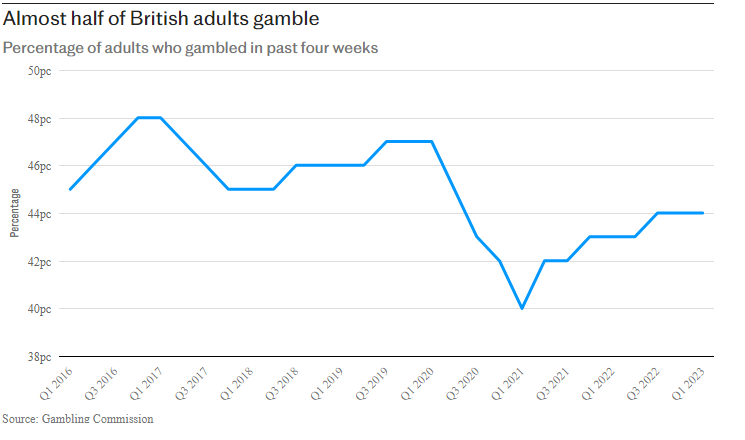
Third, is the consistency of betting: football has overtaken horseracing in absolute revenue (by only 15% in FY24 after a generation of predicted doom for racing from betting commentators who preferred opinion to evidence), but betting maintains remarkably consistent in terms of revenue mix over twenty-five years despite all the hype over growth. The relative growth in slots has therefore partially mitigated the relative decline of National Lottery revenue to keep gambling expenditure as a proportion of Household Disposable Income relatively stable at c. 1% over 25 years (note, FY9 was low because of the implementation of the Smoking Ban, the loss of S16/21 machines, and the onset of a global recession). However, an underlying decline can be detected and if the National Lottery is not turned around then it is likely to become more visible, in our view.For all the hype about a changing landscape, very little is changing in terms of underlying consumer behaviour other than channel shift. British consumers are, if anything, gambling less, albeit with revenue concentrated in a smaller number of participants.

 
The growth visible in the FY24 industry stats offers more to be concerned about than relief for a recently battered industry. For the British gambling industry to have a future that is not a story of increasingly pronounced relative decline temporarily disguised by inflation, it needs to achieve ‘just’ two things, in our view:
 ensure the legislative and regulatory framework keeps high value players in the licensed ecosystem; the opposite is currently being achieved (note, London has already largely lost a c. £150-300m annual high roller casino segment taxed at a marginal rate of 50% – sufficiently specialist to disappear largely un-noticed) create products that have genuine mass-market appeal (the Charity Lottery sector is the unsung standout success story here) 
These two drivers of industry sustainability sound simple, but they are proving dangerously elusive to deliver.
 
UK: RET policy – money, money, money: why the levy is far from funny
“What operators rightly hate being told is that they ought to be contributing more than they are to RG programs without being told what they are actually paying for. They then readily form the suspicion that most of their money is spent on the cost of employing an army of hostile public and quasi-public officials. These officials are then perceived as having as their primary concern not the alleviation of suffering but the retention or expansion of their own jobs. This in turn, can be suspected of leading to the proliferation of regulations that have little or no empirical basis.”
Professor Peter Collins, 2003
 
The decision to impoae a safer gambling levy on licensed gambling operators in Britian is by far the most ill-considered of the policies contained within the previous British Government’s white paper on regulatory reform. It is also likely to be the most significant in the longer term, with far-reaching consequences for the functioning of the gambling market, harm prevention and policy coherence.  In this article, we set out why we believe the levy is bad policy, what its outcomes are likely to be and how some of its worst consequences might be mitigated.
Why the levy is bad policy
The imposition of the ‘safer gambling’ levy has been dressed up by proponents as self-evident. After all, what could be more reasonable than requiring gambling businesses to fund the treatment of people suffering gambling disorder as well as work to better understand harm and to prevent its occurrence? The polluter, as the trope goes, should pay. 
 
The problem is that is not how our society works. In the normal world, businesses pay taxes at rates set by HM Treasury, which are used to fund public services, including healthcare, research and education. Charities, community groups, and private businesses address gaps in what the state is prepared to fund. The safer gambling levy breaks this model by requiring treatment and other costs to be funded directly from the expenditures of gambling consumers. In so doing, it sets a precedent for levies to be funded against general retail businesses (to recover costs from compulsive buying behaviour), internet providers (internet use disorder), coffee shops and teahouses (caffeine use disorder), pubs and bars (alcohol use disorder), and restaurants (obesity) among others. Followed to its logical conclusion, it proposes a healthcare system paid for by citizens according to their lifestyle choices. There is a dark and unsettling logic to this if applied consistently – but no obvious justification for its imposition on gambling consumers alone.
 
Combined with the draft guidelines of the National Institute for Health and Care Excellence, the levy will make treatment providers dependent upon the NHS through the stipulation that they may not seek funding or engage with gambling businesses – effectively penalising those organisations that support the current regulations. One consequence of this model is that – contrary to the spin – the levy increases the dependence of treatment and harm prevention providers on the industry (as a number of public health figures have already observed). In replacing a voluntary system of funding with a tax, the government will tie financing to industry revenues. If consumer spending with licensed operators reduces, so will funding. Organizations lobbying for tighter restrictions on gambling consumers (or higher taxes on operators) will do so in the knowledge that new measures may negatively impact their own finances. The Department for Culture, Media and Sport has forecast a net market contraction of 8.2% as a result of its white paper reforms but this is speculative, and the impact could well be greater (particularly if modernising reforms for landbased operators are delayed). There is a very good chance that the levy brings in less than expected, which would be a major problem if the levy was underpinned by an actual budget or assessment of need. 
 
The levy has been justified by reference to two factors: concerns over the perception of research independence under current arrangements (regardless of whether those perceptions are grounded in fact)the fact that some operators have contributed derisory amounts under the voluntary system 
The first suggests that government policy is now dictated by perception (which is in turn influenced by lobbying) rather than actual evidence. The second is a red herring – no gambling business of any scale has been guilty of under-funding; and the parsimony of the few is poor justification for the creation of a new tax, although it does justify targeted intervention.
 
The levy is also likely to be wasteful. HM Revenue and Customs already collects c. £3.5bn in specific gambling duties (in addition to general taxes less Output VAT) from the gambling industry, under direction from HM Treasury. The levy, however, envisages the establishment of an entirely new tax system, designed to collect roughly £100m under a non-fiscal authority, overseen by a levy board. While a Levy Board works well in racing, it is independently supervised with formal betting input (a board seat) and levy collected pays for clearly defined common interest objectives, neither of which apply to the safer gambling levy (although they could). Without these governance guard rails, the potential for waste, error and fraud is enormous, in our view.
 
The suggestion that the levy Is ‘smart’ appears to be Ir of those Orwellian conceits that has come into vogue in recent years (such as the idea recently expressed in the Lancet that state control is freedom). The logic for determining who pays what – including the exemption of the National Lottery – appears non-existent beyond the results of a sector and product popularity contest among the levy’s engineers. The application of a 1.1% rate to online gambling is justified by the idea that: i) it is associated with higher rates of ‘problem gambling’; and ii) remote operators have lower operating costs. The first is solely true of online gaming and is not true for betting – the ‘problem gambling’ rate for online sports bettors in the most recent Health Survey for England was just 1.2% (albeit it is dangerous to leap to causality given that PG rates are principally set by a product’s popularity). The second is true for some remote operators some of the time – but not for the many others: plenty of landbased businesses have higher margins than plenty of online businesses and the channel has little to do with the outcome. More generally, the suggestion that efficiency should be penalised hardly fits with the Government’s growth agenda. There is a reason why tax policy is generally set by finance ministries and not by regulators. Ironically, based on the premise that online gambling operators are able to pay more because of higher margins, they should be able to offset any margin-reducing tax increases with a reduced Levy rate, though we doubt the logic will be applied so robustly.
 
The levy is not so much smart as unfair. To provide one example, operators of gaming machines in bingo clubs and arcades are required to pay; but pubs and social clubs providing precisely the same machines are not. Further, the way that the Government has presented the tax is misleading because it is levied on suppliers (at 1.1%) as well as B2C operators (at between 0.1% and 1.1%). The effective rate of the new tax will therefore be applied inconsistently and at rates higher than claimed since we do not believe a recoverability mechanism (ie, the way VAT works outside the gambling sector) has been proposed – and it would make no sense if it did since gambling suppliers exist to serve gambling customers, who are being taxed through gambling operators. There is an additional irony that this highly complex levy, with multiple and arbitrary rates across different gambling products and channels, comes as the government simultaneously seeks to copy another of the previous government’s soundbite-driven schemes, since it will: consult next year on proposals to bring remote gambling (meaning gambling offered over the internet, telephone, TV and radio) into a single tax, rather than taxing it through a three-tax structure. This will aim to simplify, future-proof and close loopholes in the system. Perhaps someone needs to tune the governments’ wireless.
 
What can we expect next?
It has been claimed that the ‘safer gambling’ levy will result in greater resources and more certainty for harm prevention services, which would be a good thing. It will probably (depending on events) bring in more money than under the voluntary system; but that is not the same thing. For one thing, it will involve the creation of new administrative bureaucracy for which no published budget exists (a major lacuna) and, given the way that the state spends money, is unlikely to be either modest or well governed.
 
Half of the funds left over after as yet unknown administrative costs will be allocated to the perennially over-stretched National Health Service, which will almost certainly prioritise its own services over the requirements of the Third Sector. The charities, who have in some cases been effectively and diligently providing treatment to people with gambling disorder for more than half-a-century, will now be required to bid for the funds that were previously theirs. Several harm prevention organizations have already started to shut down programmes (including training for licensees) and making members of staff redundant (up to 150, if reports are correct). Made dependent on the state, treatment providers may find that they are required to fall in line with radical public health ideologies, such as the belief that adults bear no responsibility for their actions and harm is solely the result of exposure to ‘addictive products’. This denial of human agency breaches a core tenet of psychotherapy and has the potential to cause enormous damage to vulnerable people by institutionalising victimhood.
 
A further 30% of net funds will be allocated to the conveniently vague domain of ‘harm prevention’. Rumour suggests that the commissioner will be either GambleAware or OHID. The former has already called for mandatory health messages on all gambling advertisements (including for the National Lottery and horseracing); while the latter has manufactured suicide statistics and proposed ‘plain packaging’ (no colours, logos or images) for all gambling products. GambleAware may be slightly less illiberal than OHID, but both have trouble distinguishing between harmful gambling and gambling – a blind spot that ultimately leads to long-term prohibition via a medium-term funding bonanza. We can only imagine what they might get up to with up to c. £30m a year.
 
The final 20% is allocated to research under UK Research and Innovation (‘UKRI’). It is to be hoped that UKRI demonstrates greater scientific rigour and moral neutrality in commissioning research than the Gambling Commission, GambleAware, or OHID. The risk, however, is that it becomes a slush fund for anti-gambling activism that will be used not just in Britain but internationally to campaign for the prohibition of gambling once all the funding that can be extracted has been. In recent years, a profusion of clearly agenda-driven journal papers and reports of low academic quality have been published – often as a consequence of Gambling Commission or government funding – alongside a very small number of high-quality studies. There is a risk that the levy will be used to fuel a propaganda engine for an international anti-gambling movement. The reason why activists have prioritised the levy above all other matters is because they know just how large the prize is – up to £20m per annum.
 
For all the high-minded rhetoric, the levy seems destined to result in disruption to treatment services, increased stigmatisation of gambling as a legitimate adult pastime, and the production of misinformation on an industrial scale which politicians and bureaucrats seek to lack the discipline or inclination to critically assess. 
 
What should be done now?
The safer gambling levy may be bad policy, but it is now policy, and it will come into force next year. The question is therefore what ought to be done by licensees and others. We make three suggestions:
 Governance – there is a good chance that money raised by the levy will be used inefficiently, unscientifically and inappropriately. The process for how funds are allocated and assessed therefore requires close public attention. Scrutiny should be applied to the levy’s governance arrangements and the process of evaluation in 2030. Given what has gone before, it would be naive to trust those responsible to mark their own homework Continued support – a large number of harm prevention organisations now face uncertain futures. It would be a mistake, in our view, for operators to cease their support for charities and other harm prevention organizations once the levy kicks in even at the cost of ‘paying twice’. Several important programmes now face defunding (in addition to those that have already fallen by the wayside); and operators need insights from these groups in order to inform their own ‘safer gambling’ initiatives – for the sake of disordered gamblers and the sustainability of effective treatment, a distinction must be made between the sunk cost of a pollicised levy and productive expenditure on mitigating the harms that the licensed gambling sector does cause or exacerbate Critical analysis – the levy is likely to result in an expansion of anti-gambling activism, particularly in the domain of ‘research’, which will reach into other jurisdictions. To date, the licensed gambling industry in Britain and other jurisdictions has done an extremely poor job of assessing and (where appropriate) rebutting bad science. It is critical that it develops both the technical capability to scrutinise research and the willingness to call out misinformation (including misinformation which seems to support the industry). There is a good case to be made for building this capability on an internation basis.Ironically, the new levy is at least in part the unwitting handiwork of some of the largest licensees in Britain’s gambling industry whose lobbying made the policy almost inevitable. The Betting and Gaming Council’s endorsement of the policy was unfathomable to us at the time and continues to be so; it makes a lobbyist’s job much easier in the short-term but the industry’s job far harder in the long-term. There is a lesson here which the industry should now be able to perceive – policymaking is difficult in this space; and the pursuit of easy fixes is liable to end in disaster. Unfortunately, the government may have to wait a little longer before it arrives at this epiphany.  

Regulus partners
Disclaimer; The analysis provided in this report represents the opinions of the authors. Any assessment of trends and change is necessarily subjective. The information and opinions provided herein are not intended to provide legal, accounting, investment or policy advice, nor should they be used as a forecast. Regulus Partners may act, or have acted, for any of the companies and other stakeholders mentioned in this report.

Abusing NHS statistics

UK: ‘We don’t need no thought control’ – why the Gambling Commission should leave NHS stats alone

In recent years, the Gambling Commission has been on the receiving end of criticism from all sides of the so-called gambling debate. Last year, the MP, Sir Philip Davies declared that the regulator was “out of control”, while the Social Market Foundation has described it as “not fit for purpose”. The Commission has not publicly endorsed either of these views – or advertised them on its website – presumably because it considers them to be untrue as well as unflattering. Last month, however, the Betting and Gaming Council (‘BGC’) was asked by the Commission to make claims about the prevalence of gambling harms which are probably false – and to publish them on its website.


In an email recently released under the Freedom of Information Act, the Commission wrote:
 
“We’ve been keeping an eye on use of GSGB [Gambling Survey for Great Britain] data and use of figures as the official statistic. We’ve noticed that BGC still refers to previous stats, it’s not a misuse of stat issue but we’d be keen for you to start using the official figure moving forwards.”
 

This invitation was politely declined by the BGC on the grounds that it has greater confidence in NHS statistics (which are accredited by the UK Statistics Authority) than in the Commission’s (which are not). The BGC is similarly unlikely to profess that its members are (to borrow from Blackadder) ‘head over heels in love with Satan and all his little wizards’; but the Commission can always try.  

 
The regulator’s entreaties should be considered in the light of the following circumstances:
i) the balance of evidence indicates that the GSGB substantially overstates levels of gambling and gambling harm in Britain
ii) the Gambling Commission knows this
iii) in asking the BGC to go along with the charade, the Commission is acting, at best, inconsistently
iv) the GSGB is already being used (and misused) by activists, seeking to reopen the Government’s Gambling Act Review.


We examine each of these points in turn.  

 
1. The balance of evidence
The GSGB may be the new source of official statistics, but this does not mean it provides a reliable picture of gambling prevalence in Britain. To believe that it does, it is necessary to subscribe to the following:
        i.            Every single official statistic on gambling and harmful gambling produced over the last 17 years – by the National Health Service (‘NHS’), the Department for Culture, Media and Sport and the Gambling Commission itself – has been substantially wrong
      ii.            The NHS has serially misreported the prevalence of health disorders in general – and continues to do so
    iii.            Audited data on actual customer numbers using licensed operators is incorrect (or there is a massive black market that failed to show up in previous studies and of which the Commission was previously unaware)
     iv.            The opinion of the independent review (conducted by Professor Sturgis of the London School of Economics) that the GSGB may substantially overstate true levels of gambling and gambling harm is misguided
 

To believe that all these things are true (and to cajole others into professing the same) requires more than blind faith and a sheriff’s badge. Tellingly, the Gambling Commission does not have very much confidence in the GSGB itself; and has issued guidance that key results should be used “with some caution” or not at all.


2. Withholding evidence (again)
The Gambling Commission’s defence of the GSGB has largely consisted of attacks on NHS statistics, claiming that they have under-reported rates of ‘problem gambling’. While scrutiny is important, undermining accredited official statistics on health is a step not to be taken lightly. Some sort of evidence is required. For this, the Commission has relied upon a 2022 study which claimed social desirability response bias (ie, the fact that people sometimes answer survey questions in what they consider to be an acceptable rather than accurate fashion) caused under-reporting of ‘problem gambling’ in NHS surveys. This ‘evidence’ was thoroughly debunked by Professor Sturgis as part of his independent review – but for reasons known only to the Commission, the analysis was suppressed. It required a Freedom of Information Act request to secure the release of the information. This is not the first time that the Commission has prevented publication of critical evidence – having previously withheld survey data on customer opposition to affordability checks. Disclosures also reveal the Commission was warned by its lead adviser, Professor Heather Wardle, that social desirability response bias was likely to be a “marginal factor” in explaining differences between the GSGB and Health Surveys (and that the dominant factor of topic salience bias resulted in over-reporting in the GSGB). 
 
3. Two-tier thought policing?
In recent years, various parties have taken highly selective approaches to the use of ‘problem gambling’ statistics – often ignoring official estimates in favour of more convenient alternatives. Last year, the National Institute for Economic and Social Research did so in a report funded by a Gambling Commission settlement – using a rate two or three times higher than the official statistic. There is no suggestion that the Commission objected to this. In public consultations, the Commission itself relied on ‘problem gambling’ prevalence rates from the 2018 Health Survey for England rather than lower figures from the 2021 edition (ie, the official statistics at that time). In a speech in Rome last month, the chief executive of the Commission, Andrew Rhodes criticised those who wished to “turn the clock back” to previous official statistics, and in the very same speech cited participation estimates from ‘previous official statistics’.

 
4. The weaponisation of research
The importance of all of this has been amply demonstrated in recent weeks. Both the Institute for Public Policy Research and the Social Market Foundation cited the GSGB’s inflated rates of ‘problem gambling’ in support of demands for ruinous and self-defeating tax rates (as high as 66% of revenue); while GambleAware has used the survey findings to call for tobacco-style health warnings to be slapped on all betting and gaming adverts (including those for the National Lottery). The Commission appears, therefore, to be encouraging the use of inaccurate statistics on gambling harms in the knowledge that they will be used in support of an anti-gambling agenda.

Perhaps Sir Philip had a point after all…

REGULUS PARTNERS NOVEMBER 2024

Speed Kills!

The British Horseracing Authority is committed to a reduction of fatalities in the sport of horse racing. To that end they have embarked on a number of initiatives to achieve that end

I want to focus on the National Hunt. An area that once again hit the headlines with the loss of 3 horses over the weekend at Cheltenham. Two appeared to be post race heart events. I’m told these are not attacks as we understand them. Both of these took place over the chase course, in the same race. One other horse fell in the Greatwood Hurdle and died

The time of this chase event was the fastest chase of the day. It was as quick an event as I’ve seen, and I’ve verified this view with other form judges. These days it has become a rarity to see horses actually fall in horse racing, it seems to have become unacceptable, even if the sport is supposed to revolve around jumping ability, and clearly that’s what people pay to see. I observed at Cheltenham, whilst reviewing races, how horses clear fences at this premier racetrack with ease. Often several feet above the birch.

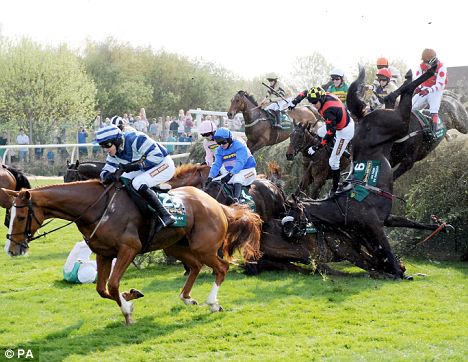
This was also readily apparent in the 2024 Grand National, where the fences have been lowered, softened and landing areas eased, to such a degree that no horse fell in the entire race. What is of most note is horses no longer bend, or arch their backs to jump. They clear fences with speed undiminished. The first fence is fairly infamous for speed based falls, as the 40/34 strong field would be at their quickest at that stage.

Whilst the BHA, under Nick Rust embarked on a programme of overall diminution of fence heights and stiffness, the fatality rate in the Grand National is currently running equal to the highest percentage rate ever. Without comment from the BHA. Since the 1960s 29 horse fatalities have occurred where ground is either good or better than good. 43 if we include good to soft. Just 5 have died in ‘heavy’ ground, and no horse fatalities were registered when ground is officially ‘soft’

Of further note, long term injuries have increased in the sport for the 4th year in a row since 2020. The lowest rate of fatalities? In 2020, when the winter was the wettest on record

With these facts in mind, is the BHA approach gaining the required results? To me their approach is centred upon optics. Where they have defined form! If we have fatalities, make the test easier has been the code

I would argue their approach focusses on the difficulty in jumping hurdles, or chases, when they should be focussed on ground, and speed. In simple terms the horses have quickened up. This is the inevitable consequence of making the obstacles easier

When the Grand National fences were at their fiercest, in the 1960s, just 2 fatalities were registered. Can the BHA explain this? Anyone who wandered around the track in the 3 or 4 decades since then, could only have been impressed by the scale of the fences. It was what people tuned in to see. The BHA’s approach in my opinion has been naive on two fronts. It increased the rapidity of racing, and it made the sport’s showcase less compelling to the viewing public, as evidenced by television audiences worldwide

This is what happens when you allow a betting executive free reign to mess about with the sport, with optics as his focus. I recall his comments on the heavy ground 4 miler at the Festival, where several horses finished notably tired and jumping became ragged. There were no fatalities in that race, but the race was identified by Rust as having ‘more fallers and horses brought down.’ Hardly surprising at Cheltenham’s longest chase event! It became clear that Nick Rust’s epitath was to nailed to his views on horse welfare. He reduced the race by a quarter of a mile and questioned the participation of the amateur riders involved.

One final point, before I leave you to discuss these points. Remember Cheltenham’s ill fated 3rd last fence? A notorious obstacle, not because it was taxing, but because it was at a critical downhill part of the track, where horses were speeding up. They tended to overjump, and collapse with fatigue on the landing side.

Make me the CEO of British Racing – I would increase the height of fences once again, and their stiffness. Force horses to slow down several times a race. I would demand tracks water more assiduously in the winter to produce soft ground. I would do everything possible to slow these impressive animals down. Speed is the killer in British Racing. Not the difficulty of the obstacles they face

The Chancellor would be wise not to kill one of Britain’s few remaining golden goose industries

“I know we cannot tax and spend our way to prosperity.”

These were the words of Chancellor Rachel Reeves to the business community ahead of this week’s International Investment Summit. This was an event she championed as a way to try and promote growth.

I cannot agree more with those sentiments. But taxing business to the point of oblivion will hobble growth, not deliver it.

The Betting and Gaming Council (BGC) members I represent annually generate £6.8bn into the economy in gross value added, according to figures compiled by EY. They raise a further £4bn in tax for the Treasury, while supporting 109,000 jobs.

This is a huge business, with around 22.5m adults in the UK enjoying a bet each month. The overwhelming majority of them do so safely and responsibly. It is part of our British heritage and culture as well as a bastion of the leisure and entertainment sector. It has made our members – companies such as Flutter, Entain, evoke, Bally’s and bet365 – global leaders, generating billions for the UK.

Crucially, these are not just London-centric operations. Our members have headquarters in Stoke-on-Trent, Newcastle-under-Lyme and, as the Chancellor rightly recognised, in her very own city of Leeds.

We have always been clear that proportionate regulations and a stable tax regime are the only foundations which can deliver on the Chancellor’s ambitions. In order to continue to invest and grow, our members need confidence and stability. Both have been in short supply in recent years.

When the previous government finally published the Gambling Act Review white paper, the BGC welcomed the balanced and proportionate measures it contained.

However, there is no sugar-coating the reality: it will cost our sector well over £1bn a year in lost revenues once all the measures are implemented. It includes a new tax in the form of a statutory levy of £100m a year to fund research, prevention and treatment services to tackle problem gambling – an issue the NHS’s Health Survey for England has confirmed affects just 0.4pc of the adult population.

As we wrestle with those seismic changes, the last thing we need is a further tax rise being demanded by anti-gambling campaigners. They gleefully claim that increasing taxes as high as 50pc will raise billions for the Treasury, while having zero impact on businesses, jobs or key sports we fund such as horse racing. It’s fantasy economics and they know it. Any tax rises now, of any scale, will land a hammer blow to one of the Chancellor’s few growth sectors.

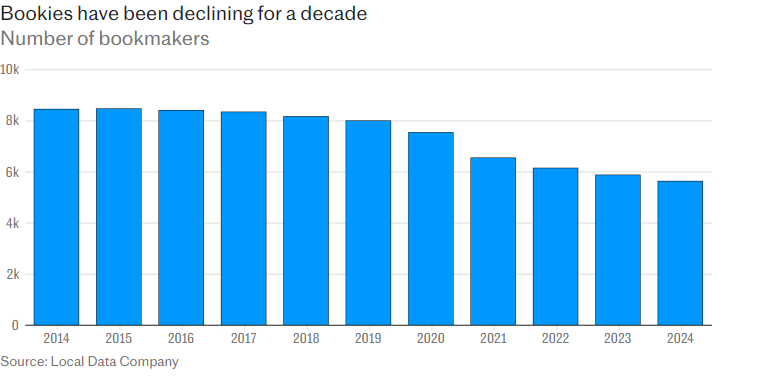
Contrary to the cries of campaigners, betting and gaming is not a soft target. Putting up taxes or imposing draconian regulations does huge damage to businesses. For example, recent regulatory changes directly contributed to 2,485 bookmakers closing since 2019 – a 28pc reduction with the loss of over 10,000 jobs and the business rates they generated. 

You cannot put “rocket boosters” under sectors such as ours, as Liz Kendall, the Secretary for Work and Pensions, said at the Investment Summit, while also slamming the brakes on our industry with tax hikes and changes which drive customers away.

The pain is also not restricted to our members, it directly hurts sport.

Horse racing is the most obvious. The affordability checks – a construct totally unique to betting – has hastened double-digit percentage declines in betting turnover, effectively making it close to a loss-making product for some of our biggest members.

Football, especially in the lower leagues as well as in rugby league – a sport much lauded by Lisa Nandy, the Culture and Sport Secretary – along with other working-class sports, such as snooker, darts and boxing, rely on the income betting delivers. Hit betting and you will hit sport, from the grassroots to the elite level.

There is another issue blithely ignored by armchair economists, the growing threat of the unsafe, unregulated black market. A recent study found 1.5m Britons stake up to £4.3bn on this gambling black market. These operators offer deals too good to be true, circumventing the crucial player protection tools standard across BGC members. They also don’t pay tax, don’t create UK jobs and don’t support sport.

Rachel Reeves is right to go for growth. So it would make no sense whatsoever in the Budget to over-tax a gambling industry which has been hit hard by the Government in recent years. We want to play our part in investing and helping to grow the economy. The Chancellor would be wise not to kill the goose that is already laying the golden eggs. 

Grainne Hurst- Betting and Gaming Council CEO

From the Telegraph

What happened to racing?

More than a decade ago, I sat down to lunch with the eminently amiable Simon Bazelgette. At the time one of the decision makers in the s[port, as leader of Jockey Club Racecourses. My online business was fledgling, years behind 365, I spent my time with reasonable prominence on racetracks with good pitches, and laying bets others would not. My interest lay in attendances at racetracks

He told me of their plans to bolster what was a successful sport, with concerts. The unspoken master plan involved a lake of beer.


For a while, the plan seemed to work. Top acts were booked, and given this was all new territory, their rates were affordable. Racetrack sales grew, alcohol seemed a happy marriage as Bazelgette’s argument was tracks needed to ‘evolve’ to become more of a leisure day out, than a sport. Not that he associated alcohol sales in conversation

Over the years, the top acts, other than legacy performers well past their sell by, like Tom Jones and Rod Stewart, raised their rates, and the maths started to bite. A clear example was Epsom (I might refer to this old Dame a few times) which booked concerts by acts most regular attendees of tracks had never heard of, and put on six class 6 races for pocket money. Yes, you heard that right, whilst claiming the practice was to encourage fans into the sport, they often afforded exceptionally poor racing. Being Epsom, some of the field sizes were miserable. But the track was busier than ever, and profitable for a change. All seemed good in the world of racing. The formula was taken up across the sport

There were downsides, but these seemed trivial when a night meeting at HQ could draw in 15,000, and beer sales were impressive. As were the vital corporate boxes. For example what were the views of their older core membership to seeing the racing programme often dumbed down? Did they relish sharing their sport with large groups of young men and women, too drunk to stand by the third race? A category of spenders were sold members enclosure tickets. 

Bazelgette told me ‘racing entrance charges are favourable against football’

But Simon should know, as every racetrack should, racing is 90% downtime – filling empty space rather than a seat, and often features a rather poor betting only product. Football is 100% action. Even cricket beats Racing comfortably in said regard. So if your leisure product is simply beer- it better be a superb environment to keep people entertained for 4 hours!

Worst of all, the brigades of sockless wonders brought aggression to the sport. Fights at venues like Epsom, Ascot and Newmarket were constant. I witnessed many of them personally, as I am sure we all have. The regulator of the sport, the BHA, looked on impassively. It never sanctioned a single racetrack for their failures to deliver a safe, fight free environment for all. One would have imagined social responsibility to be the domain of the regulator, but fat chance when BHA executives are selected by racetracks

Drugs were rife too, with queues for cubicles at toilets on a biblical scale. Children were actively discouraged from attending at tracks like Epsom by pricing policies of full adult rate for a child. It was as cynical, as it was short sighted. A decision without question because the track executive considered the environment as simply too toxic for the young. And i wouldn’t disagree! I watched huge enterprises like Ascot, the Kings racetrack, throw its effluence casually out onto the local community at 6 o clock, without mind of the consequences, nor the effect on the local community

This was the business plan for racetracks, but not the sport. Of course it all came to a grinding halt when the rates for bands became untenable. Although the beer sales remained. At some formerly impressive tracks I’ve seen beer machines spring up. I mean, I ask you what socially responsible business does that? What kind of culture are you trying to create when a pint of beer is sold by a machine, and overpriced champagne is served in a plastic beaker? Aren’t you trying to create a civilised, cultured environment? Who is governing who gets a drink, or when is enough? Perhaps a student attendant at best. Coffee, the highly popular staple diet of high streets across the country, has never been taken up properly by track execs. It can take several minutes to make a coffee, just seconds to pull a pint. It boils down to money over service standards

Finally, as far as racetracks are concerned, there’s the cynical pricing practices. Charging the maximum for meetings which appeal only to betting. Racegoers finding bars and restaurants closed. How some tracks can charge £120 for a bottle of champagne – served in a plastic cup, on cheap tables, whilst the same bottle in York costs half that amount? Car parking charges are excessive. No track is exempt from criticism here. The food on racetracks – outside the private boxes is notorious. What would tracks do without vans serving chips? There used to be an excellent sweetie van at Ascot, run by people who have provided such a service for years at many racetracks. It’s been replaced by a dismal track equivalence. Why? Because new management have decided it to be more profitable in house. The service angle has been shelved in importance. The same people no longer serve Goodwood. Why? Because they can’t afford the rates. Now noone offers that essential service, with such panache

Tracks have gone cashless, often refusing to countenance any cash sales, from punters who arrive at the track with cash only for bookies, and who, when they win, cannot spend it at the venue. This kind of management is child-like. The current estimate of cash circulating in society is 82 billion. And the tracks have decided they don’t want any of it? It is an astonishing fail. Me? I’d take green shield stamps..

Cash is legal tender, and if you’re not going to take it, make it clear when people buy a ticket that you refuse to accept the paper. 

In the simplest terms possible, racetrack executives have markedly contributed to their own downfall. With cynical pricing practices and quite often severely run down racetracks, lacking appreciable investment

One final point, I think racetracks appear to have missed. They’ve become almost universally unpopular with their patrons. Few letters appear which glorify the experience. Few articles laud racetracks for service, value or customer experience. And noone likes their attitudes to social responsibility. In said regard they rival ‘big corp’ bookmakers for popularity. With few exceptions.

For two decades almost, I have railed against the practice of breeding in the sport. Let me give a topical example, – City Of Troy. A rather in an out character, with sour performances in the Eclipse and the 2000gns. In between which, on going days, he can be endlessly impressive. The general public, and more importantly the racing crowd, have started to associate with this new star. Bolstered by plaudits ‘best i have ever trained’ from the very likeable, and hard working Aiden O Brien. He could sell me windows any day, training is just his day job. They were even afforded a racetrack gallop at Southwell, the performance enhancing element for which was unclear, since its characteristics against Del Mar, California, appeared only to be the running rail. I mean if you want a racetrack gallop – and you live in Ireland- Dundalk is just up the road.

What it was, however, was a giant sales pitch. City ‘raced’ against some of the worst horses in the AOB yard, and duly ran away. A visual display. A clever marketing ploy to up the price of breeding to those interested. Given it was covered by many racing journalists and television, it was an enterprising move, rewarded with coverage far beyond its worth

I think we all know if City Of Troy wins in Del Mar, that we will hear he is to be retired. At best, this performer won’t make it on a racetrack to 5 years. And this is the true cancer in the sport. Horses carted off to stud far too early in their careers. It is indeed a rarity for anything winning France’s Arc to continue on. The call of a lucrative career making other racehorses far too compelling. Tattersalls book 1 registered a staggering 134 million in sales this October. An absurd figure for an auction notorious for delivering on failure for the majority of purchases. Could there be a bigger bubble?

Troy will yield an impressive purse at stud, far more gained in a month than could in a career as an actual race horse, entertaining the general public. And this, my friends, is where the real money in racing is. Not actually racing.

Breeders will argue, and some may agree, that his progeny will entertain racing fans for a decade. That argument, however, falls entirely flat when you look at what draws in fans to other sports. Lionel Messi has been entertaining football fans for more than a decade. Joe Montana did the same in the NFL, and Johnny Sexton wowed rugby fans until his body gave out. Racing farms its best out to barns in a naked exercise in cash creation

This is what brings people to sport. In tangent with an ability to adapt. Cricket is the best example of that, introducing twenty twenty slogs, and 50 over games to afford fans the one day bash they craved. They still keep the 5 day borefest of course, for the aficionados, but attendances are modest. The NFL routinely changes its laws and rules, ensuring every team across the nation has a chance at the Superbowl. Dallas used to dominate, now they’re a mid table performer. The system of capping and drafts arresting billionaires from buying their way to enduring success

And whilst other sports have been improving their offering? The BHA have been watering down its fare. Banning hard pressed jockeys for obvious errors, a clear violation of their human rights. Low sun meriting bumper races. A massive dumbing down of National Hunt fences, the leading example of this would be the sport’s shop window. The Grand National

Now I do understand that for a decade animal rights campaigners have hung around Aintree, peddling their views. They should be easy to counter, over 90 percent of the animals they ‘save’ are euthanized! Any attempt to ban racing would amount to the biggest cull in the horse ever undertaken, and critically the RSPCA sees no issue with horse care. In the last few years, Aintree has experienced more horse deaths in the National than in the entire decade of the 60’s. It seems to me that speed kills with far more effectiveness than the height or stiffness at fences.  Look at Cheltenham’s 3rd last, now removed. It was rightly accepted that with the downhill nature of the fence, the tiring horse being asked for extra effort, led to fatalities. Nick Rust decided it was all about height, and the latest industry patsy, Julie Harrington, without doubt the most ineffectual leader the sport has ever engaged, it was also about how many actually took part.  

The clear and indisputable result was a race where over 4.5 miles, not a single horse fell. Not one. And in previous years I watched the same farce being played out with the number of finishers determined by those who pulled up.

The shop window has seen a huge decline, despite an attractive time slot, in the number of people watching the race. A nod to animal rights- has become the sports headstone, indeed they’ve created a monster. Hearts in their mouths every year-and with the inevitable spectre of future horse fatalities, will require another response. That’s how appeasement works.


Some folk in racing are waking up to the third issue. Trainers. The sport is ruled by a miniscule posse of top trainers. The aforementioned O’Brien, dominates the flat, and has become so powerful he can openly flout the rules of the sport, employing team tactics for example, to ensure his stars have the ideal pace and running line. Horses with best form at 7 furlongs sent out in Irish Derbys to provide the best environment for other horses in the stable. O’Brien may be breaking the rules, but he’s not doing anything wrong. Why? Because it is condoned by the authorities, and therefore he has cleverly made it legal.

The Irish racing regulator, Horse Racing Ireland came up with a novel plan to limit just 60 races in its programme to trainers who had fewer than 50 Irish Hunt winners. There were endless good reasons for such a plan, if you want to reduce the power of Mullins and Elliott, and to a lesser extent the likes of De Bromhead and Cromwell, from winning everything meaningful. It is precisely why other sports employ salary caps. Such dominance in any sport is deeply unhealthy, and pressurises small trainers out of business.  Mullins, for example, can withdraw his horses from a particular meeting and the bottom drops out of all interest. These 4 trainers were rumoured to be considering legal action, to protect their dominance, which merely serves to illustrate how self serving they are

Add that to the endlessly ruinous practices of other horse husbanders, like Nicky Henderson, withdrawing top stars from races at the eleventh hour, with a range of spurious excuses. Without due care for those who have bought a ticket. It is about Seven Barrows, rather than the National Hunt, and I’m afraid that’s as unacceptable as Manchester City deciding not to play its best players, because the opposition might be a bit stiff

Both the BHA, and Horse Racing Ireland have afforded trainers luxuriant opportunities to gain coveted black type. This has several major benefits to owners, breeders, trainers – but not the tracks. Naturally a row of often cheaply gained graded wins raises the profile, price and stud fees, and racetracks see offering graded events as important to attendance. Such has become somewhat of a millstone. Racing channels, pundits, hacks can all laud the performances of horses like Constitution Hill, but they are gained at the expense of competitive racing. I struggle to understand the eye watering fawning over such performances, when those who could make the race of merit to fans and television are boxed up and sent elsewhere. Ultimately, however, the practice has hit the sport hard, with  a marked decline in attendance. Aficionados can glorify group races like the Eclipse, Goodwood Cup or Champion Hurdle – but they remain utterly meaningless in terms of competitive fare, and for the betting public at racetracks? An irrelevance

Racing is not helped by its inward looking approach. Too many decisions involve self interest, the views of John Gosden, the tracks themselves, or the breeding community. Racing’s hierarchy is drawn from the sport almost exclusively and there are precious few new ideas. Attempts at change are derided as unnecessary – or even face legal challenge. Either that culture changes or the next generation could be looking at a severely diminished sport. 

Affordability checks in the gambling medium can only negatively impact racing coffers. I understand the reaction of the tracks will be to run to government to renegotiate what they earn from bookmakers. This has always been just so. It is a poor business practice, however, to refuse to accept the sport has declined in interest and competitiveness, and not to care that bookmaker returns in an expensive sport to operate are borderline, and racing’s most important stakeholders – punters, are fast losing interest in betting on the sport. They would rather bet on the slots, according to the latest set of financials from the GC.

Black type should be at a premium. Everything that can be done to increase competitiveness and participation must be addressed. Racetracks need to stop treating the sport as a by product to their publican tendencies. Prices cannot rival football, because racing isn’t as good as football. And the practice of breeding has to be robustly challenged with measures designed to make it a lot more difficult for horses to line up a row of 1s. The sport isn’t about 10 trainers.

Most sports would have woken up to its issues and taken full ownership a long time before now. In simple terms our decision makers view the sport from the corporate box, and show no understanding of why people are voting with their feet elsewhere

When racing was threatened by the prospect of a massive drop in income with the gambling commission’s utterly futile affordability checks on punters, a petition was taken up to get Parliament to debate the matter further. I recall it took nearly two weeks to gain 100,000 signatures. A sport with at least that number of people who depend on it for employment or business struggled to muster support. Why? Because the air of snobbish indifference to those who bet on the product came to the fore. The idea what is good for a bookmaker as good for the sport, not an ideal they care to support. Which highlighted a patent lack of understanding how the sport is financed by many. I have had many conversations with people in the sport who simply do not understand how dependent they are on betting! Punters themselves have felt entirely disenfranchised by association with racing. Overcharged when they attend for a very poor sporting product. Treated poorly by big betting corporations, and ignored by the authorities such as the BHA and gambling commission. The latter who actively punishes them for transgressions by major betting giants. Not difficult to see their indifference.

If racing is to get through this crisis, it simply needs a new authority. Which isn’t hired by the sport. Given free rein to sweep through changes. Punish racetracks for social failures and inadequate facilities. Enough of vanity Group 1s like Saturday’s Dewhurst. 5 ran- 2 owners. Weighed in. And the breeders? Well, they are racing’s true enemy. Forcing lesser owners out of association and robbing the sport callously of its stars as juveniles. Think that’s an extremist view? Well, tell me in November where to find City Of Troy.

ABSURDENOMICS

Absurdonomics: Bad money or poor education?


This week, Baroness Twycross participated in her first public discussion on gambling regulation, since being handed the policy brief in the summer. It was a salutary experience for the new minister, who may now be starting to grasp just how murky, partisan and at times downright dishonest the so-called gambling debate has become.
The minister will have been disconcerted to hear from fellow panellist, Professor Adrian Pabst of the National Institute of Economic and Social Research (‘NIESR’), that the costs to the state of ‘problem gambling’ could now be in the region of £5bn a year. It is likely however, that her counterparts at the Department of Education would have been even more alarmed if they understood how the professor had managed to arrive at this figure.


Last year, NIESR published its report on the ‘fiscal costs and benefits of problem gambling’. It asserted that harmful gambling cost the British taxpayer at least £1.4bn a year – a figure that hinged on its estimate that 0.7% of adults in Britain were ‘problem gamblers’. Since then, the Gambling Commission has published a controversial new Gambling Survey for Great Britain (‘GSGB’), which indicates a prevalence rate of 2.5% instead.

Professor Pabst appears therefore to have upweighted his previous estimate in line with this new figure. There are, however, two obvious problems with this. First, the GSGB is an unreliable survey – irretrievably damaged by selection bias – and the Gambling Commission itself has said that it cannot be used to provide population level estimates of harmful gambling (which is precisely what the NIESR revision relies upon). Second, the original NIESR cost estimate of £1.4bn is largely made-up!!

Roughly 60% of NIESR’s 2023 cost estimate refers to excess use of Universal Credit by ‘problem gamblers’; and was calculated using data from the ONS ‘Wealth and Assets Survey’. The ONS survey however, contains no information whatsoever that might be used to identify ‘problem gambling’; and so NIESR invented its own. It decided for example, that anyone who had won £500 or more in the previous two years and was not working due to ill health must be an ‘at risk gambler’.


Its criteria for identifying ‘problem gamblers’ meanwhile, was so speculative that it encompassed people who did not gamble at all. In this way, NIESR conjured a ‘problem gambling’ cost estimate of £800m a year out of thin air (and this presumably rises to £2.9bn using the Pabst rate of inflation).The next biggest area of alleged cost involves excess use of hospital inpatient services and was based on results from the 2007 NHS Adult Psychiatric Morbidity Survey. This dataset does at least contain estimates of ‘problem gambling’; but NIESR’s figure of £447m a year in costs (32% of the total) was based on a ridiculously small sample of just nine survey respondents; and the calculation was neither provided nor explained. The remaining 11% of costs were derived using similarly weak methods. The report is riven with flaws (including basic errors of addition, multiplication and division) and inconsistencies (it provided no fewer than four different cost estimates for excess use of GP surgeries by ‘problem gamblers’).

The project was overseen by an expert advisory group, chaired by Dr James Noyes of the SMF, a long-standing collaborator with Professor Pabst. Dr Noyes also chaired this week’s SMF event in Liverpool. Other members of the expert advisory group included Professor Heather Wardle from the University of Glasgow and Dr Henrietta Bowden-Jones of the NHS. At the time of its publication, Professor Wardle described NIESR’s work as “an important new report”, which showed that “the fiscal burden of gambling harms in the UK…have been underestimated”; somehow overlooking the myriad problems with how it was put together.

NIESR’s report was funded by a £140,050 regulatory settlement approved by the Gambling Commission – but the market regulator has expressed a lack of interest in the quality of output or the fact that some of those involved have used the report for the purposes of anti-gambling activism – not just in Britain but in New Jersey too. Regulatory settlement rules stipulate that funds must not be used for campaigning or lobbying – but as the Commission does not actually check what is done with settlement funds and provides no sanction or recourse for misuse – this rule is of only academic importance.

Professor Pabst’s comments this week may constitute a breach of settlement fund rules as well as the Gambling Commission’s guidance on the use of the GSGB – although the latter is so ambiguous that it would be hard to apportion too much blame.

The NIESR report forms part of a wider canon of studies claiming substantial social and economic costs from gambling. Earlier this month, Nera Consulting published a report alleging that online gambling was economically harmful because it diverted consumer spending away from more labour-intensive industries. Nera’s claim revolves around the idea that people should spend their money, not on things that they enjoy but on goods and services that require large numbers of people to produce them. Similarly, a report from the SMF in 2022 suggested that online gambling was economically harmful because it did not involve extended supply chains – a bizarre claim in an era of environmentalism.

Public Health England, the Office for Health Improvement and Disparities and the Institute for Public Policy Research have also produced a variety of speculative and, in some cases, misleading cost estimates.

Large sums of money have been expended on these projects – both by the state and by one private individual in particular – but it’s unclear what has been learned as a result (aside from the fact that basic numeracy appears not to be a requirement to work for an economic think tank). Even if researchers were able to provide meaningful estimates of costs, it is questionable what policy purpose they might serve without a similarly rigorous estimate of consumer and societal benefits. While Baroness Twycross heard much about the ‘bad money’ of betting, we must hope that her eyes have been opened to the absurd economics of the gambling debate.

Note: In 2023, we shared our critique with NIESR and asked (on several occasions) whether the authors considered any aspects of our analysis to be incorrect. We received no response to our enquiries.
REGULUS PARTNERS